Guide · For homeowners
How much snow can my roof hold?
By Nivometra · Updated September 28, 2026
There is no universal answer — and anyone who gives you one without asking where you live is guessing. But the question has a real structure: what snow weighs, what your roof was designed to carry, and how to find the number for your address. This guide walks through all three.
- a foot of fresh, fluffy snow
- 3–5 psf
- a foot of wet, heavy snow
- 20+ psf
- yearly chance of exceeding the 50-year ground snow load
- 2%
Snow weight is about density, not depth
Two feet of snow on your roof can be a non-event or an emergency, because snow density varies enormously:
- Fresh, fluffy snow — roughly 3 to 5 pounds per square foot for each foot of depth.
- Settled snow that has sat for days — roughly 12 to 20 pounds per square foot per foot.
- Wet, heavy snow — 20 pounds per square foot per foot or more. Heavy rain falling onto an existing snowpack can soak in and add weight on top of that.
- Ice — about 57 pounds per cubic foot; even a thin ice layer outweighs a lot of powder.
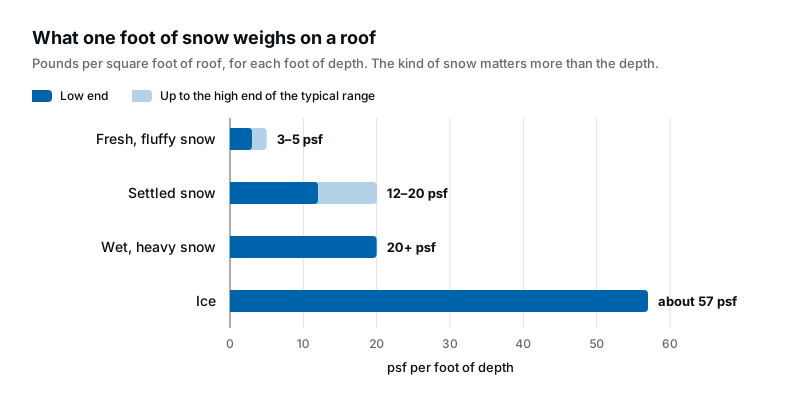
So “how deep is it?” is the wrong first question. A winter’s accumulated, rained-on, refrozen snowpack is what design values exist to describe.
Roofs are designed to a number
Every code-built roof was designed to carry a specific snow weight, in pounds per square foot. That number starts from the ground snow load for the site — the standard statistical measure of how much snow weight a location’s worst winters deposit, defined as the value with a 2% chance of being exceeded in any year (often called the 50-year value). The building code then adjusts it for your roof’s wind exposure, slope, and insulation, and for drifting — the snow that wind piles against walls, into valleys, and onto lower roofs, which is how roofs often actually get overloaded.
That is why the honest answer to “how much can my roof hold?” is another question: what ground snow load was your roof built for, and what is the real value at your site? In flat country the two are usually close. In hilly or mountainous terrain, the mapped value your builder used may not describe your specific elevation and surroundings at all.
Warning signs a roof is overloaded
Get people out and call a professional if you notice, during or after heavy snow:
- Sagging in the roofline, ceiling, or ridge.
- New creaking, cracking, or popping sounds.
- New cracks in walls, drywall, or masonry.
- Interior doors that suddenly stick or won’t latch.
And a safety note that outranks everything else in this guide: do not climb onto a snow-loaded roof. Anything that needs someone up there is a job for a trained professional with safety gear.
Finding the number for your address

The federal government’s snow-load research lab (CRREL) maintains the station measurements and the method — published as SR-20-1 — for estimating the ground snow load at a specific site from the weather stations around it, known as a ground snow load case study. Nivometra runs that method as software: pin your address, and it finds the relevant stations and sets up the analysis. Exploring the site, the stations, and a preview of the report is free; the documented case-study report — the calculated value plus the stations and analysis behind it, ready to hand to an engineer, contractor, or building department — is $29. See a full sample report.
Frequently asked questions
- How much does snow on a roof weigh?
- It depends far more on the kind of snow than the depth. A foot of fresh, fluffy snow can weigh around 3 to 5 pounds per square foot; a foot of settled snow roughly 12 to 20; a foot of wet, heavy spring snow 20 or more; and solid ice about 57 pounds per cubic foot. That is why depth alone can be misleading by a factor of seven.
- Should I shovel snow off my roof?
- Only with real caution. Working on or under a snow-loaded roof is dangerous, uneven removal can create worse unbalanced loading, and shovels damage roofing. If you believe the load is serious, a roof rake from the ground on the eaves, or a professional removal service, is the safer path — and persistent worry is a sign to get the actual design number and an engineer's opinion instead of guessing.
- What is the difference between ground snow load and roof snow load?
- Ground snow load is the weight of snow on open, flat ground that a site should be designed for — the standard reference statistic for a location. Roof snow load is derived from it by the building code, adjusted for the roof's exposure to wind, its slope, its thermal behavior, and drifting. Engineers start from the ground value; that is the number a site-specific report gives you.
- Do I need an engineer for a garage, addition, or carport?
- For anything structural, yes — a licensed engineer or the prescriptive tables in your local code, applied by your building department. A documented ground snow load for the exact site is the input those paths share; having it in hand makes both conversations shorter.
Engineer on a project? See ASCE 7-22 ground snow loads: what changed.
This guide is educational content, not engineering advice. Structural decisions for a specific building should be made by a licensed engineer or your local building official.