Guide · For engineers
ASCE 7-22 ground snow loads: what changed, and where site-specific studies still fit
By Nivometra · Updated September 28, 2026
ASCE 7-22 made the largest change to ground snow loads in the standard’s history: the national uniform-hazard map is gone, replaced by reliability-targeted values served from a geodatabase. Here is what changed, why, and what it means if your practice relied on the old map’s case-study zones.
- less case-study area than on the ASCE 7-16 map
- 90%+
- load factor on ASCE 7-22 snow loads, down from 1.6
- 1.0
- more years of snow data behind the new values
- ~30
How ground snow loads worked through ASCE 7-16
From its early editions through ASCE 7-16, the standard published a national ground snow load map of uniform-hazard values: the load with a 2% annual probability of being exceeded (a 50-year mean recurrence interval), used as a service-level load with a 1.6 factor in strength design. The map was built largely from CRREL’s station analysis, with data ending in the early 1990s.
In mountainous terrain the map gave up: large regions — much of the Rocky Mountain West, plus parts of New England and the Northwest — were shaded as case-study (CS) zones, where the designer was directed to establish the value from a site-specific study. Several states responded by publishing their own studies, which ASCE 7-16 incorporated as state tables; values could jump discontinuously at state lines.
What ASCE 7-22 changed
ASCE 7-22 replaced that map with reliability-targeted ground snow loads — the first loads in ASCE 7 to target uniform reliability rather than uniform hazard. At a glance:
| ASCE 7-16 and earlier | ASCE 7-22 | |
|---|---|---|
| What the value is | Uniform hazard: 2% yearly chance of being exceeded (50-year) | Reliability-targeted, calibrated to the standard’s safety targets |
| Load factor (LRFD) | 1.6 | 1.0 |
| Risk category | Snow importance factor applied to the load | Separate values per risk category |
| Where values come from | National map, plus state tables | ASCE Hazard Tool geodatabase |
| Case-study (CS) zones | Much of the Rocky Mountain West, plus parts of New England and the Northwest | Cut by more than 90% |
| Referenced by | 2018 and 2021 IBC | 2024 IBC |
The practical differences, in more detail:
- Strength-level values. The mapped loads are used with a load factor of 1.0, not 1.6. They are calibrated directly to the safety targets in Chapter 1 of the standard.
- No more snow importance factor. Separate values are published per risk category instead.
- A geodatabase, not a figure. The values come from the ASCE Hazard Tool’s ground snow load geodatabase — the printed figures are explicitly non-design illustrations.
- A new underlying study. The values were developed by Bean, Maguire and colleagues from roughly thirty additional years of snow data and updated depth-to-load conversion, with spatial mapping that removes the old discontinuities at state boundaries.
- Case-study regions cut by more than 90%. The remaining CS zones are essentially limited to sites higher in elevation than any nearby measurement location.
The 2024 IBC adopts ASCE 7-22, so these loads arrive wherever the 2024 code is adopted. Jurisdictions on the 2021 or 2018 IBC continue to reference ASCE 7-16 and the old map.
Where site-specific studies still fit
A reasonable first read of 7-22 is that site-specific work is over. In practice there are four situations where it remains exactly what the code expects:
- Projects under older editions. Many jurisdictions still enforce codes referencing ASCE 7-16 or earlier, where CS zones are live and a case study is the prescribed path.
- The commentary’s standing rule. Every edition of ASCE 7 has said that a detailed study of a site may produce a value lower or higher than the map, and that the study’s result should be followed. That language survives in 7-22: a defensible site-specific value, accepted by the authority having jurisdiction, can supersede the mapped one.
- Jurisdictions that say so explicitly. California building officials, for example, published guidance confirming the continued availability of site-specific case studies under 2024 CBC §1608.2.
- Terrain the grid can’t resolve. Gridded values are interpolations. In steep terrain, where snow loads can change dramatically over short distances, a station-based study of the specific site remains the honest answer — the same reason the remaining CS zones are elevation-driven.
One honest caveat. A case study submitted under ASCE 7-22 must deliver values on the standard’s strength-level, reliability-targeted basis. A 50-year uniform-hazard estimate, the kind SR-20-1 produces, is the prescribed case-study answer under ASCE 7-16 and earlier; under 7-22 it is background reference, not a value you can substitute for the mapped one.
For how a study is done step by step, and what a building official expects to see, read what a ground snow load case study is and when you need one.
What SR-20-1 is, and how Nivometra uses it
ERDC/CRREL SR-20-1 (2020) is the federal case-study methodology: CRREL’s database of more than ten thousand measurement stations and its procedure for estimating a site’s 50-year ground snow load from the surrounding stations — filtering by distance, record length, and elevation, then regressing load against elevation. It is the same family of analysis CRREL has performed for federal agencies for decades, and it meets ASCE 7’s requirement that a case study rest on an extreme-value analysis of nearby station data rather than a single point. Its output is a 50-year uniform-hazard value: the form the case-study provisions of ASCE 7-16 and earlier call for.
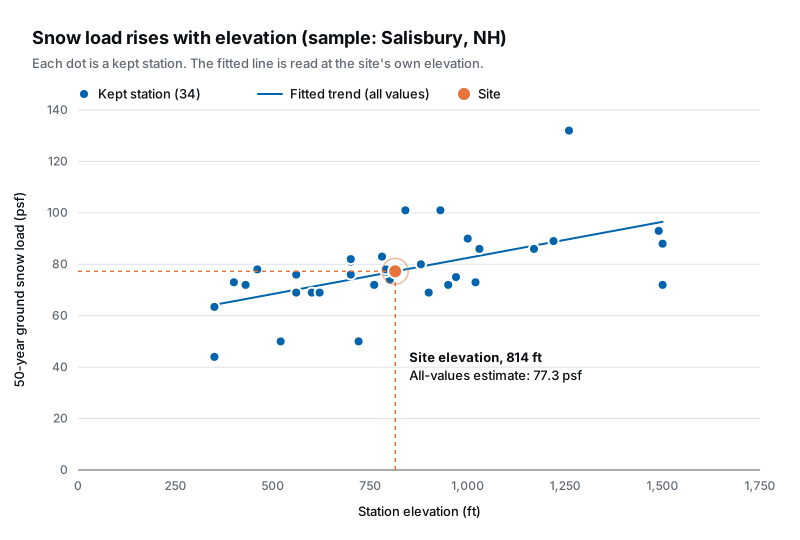
Nivometra runs that methodology as software: pin a site, see the stations the filters select, and generate a documented case-study report — the estimated 50-year ground snow load with the inputs, stations, and elevation regressions it rests on — for $29. The workspace is free to explore.
Frequently asked questions
- Did ASCE 7-22 eliminate site-specific case studies?
- No. The mapped case-study regions shrank by more than 90% because the new geodatabase covers far more locations, but ASCE 7 still permits a site-specific case study, and its commentary has always said the results of a detailed site study should be followed, whether higher or lower than the mapped value. Jurisdictions such as California explicitly confirmed case studies remain a valid compliance path under the 2024 code. Note, though, that a case study under 7-22 must deliver values on the standard's strength-level basis, not a 50-year value.
- Do I still apply a 1.6 load factor to ASCE 7-22 snow loads?
- No. ASCE 7-22 ground snow loads are strength-level (reliability-targeted) values used with a load factor of 1.0 in LRFD combinations. Applying the old 1.6 factor to a 7-22 value double-counts the margin. Loads from ASCE 7-16 and earlier remain 50-year service-level values that take the 1.6 factor.
- What happened to the snow importance factor?
- It was eliminated. ASCE 7-22 instead publishes separate ground snow load values per risk category, so the risk adjustment is built into the mapped value rather than applied as a multiplier.
- Which edition applies to my project?
- Whichever building code your jurisdiction has adopted. The 2024 IBC references ASCE 7-22, but many jurisdictions still enforce the 2021 or 2018 IBC, which reference ASCE 7-16. Local amendments can also override the maps in either direction — the authority having jurisdiction always has the final word.
- Is a 50-year ground snow load still a meaningful number?
- Yes, with a caveat. Under ASCE 7-16 and earlier it is the design basis itself, and under any edition it remains the standard statistical summary of site snow history: a 2% annual probability of exceedance. Under ASCE 7-22, however, the mapped values sit on a strength-level basis that is numerically much higher, so a 50-year estimate is not interchangeable with them. There it serves as background reference for a project team, not as a substitute for the mapped value.
Homeowner rather than engineer? Start with How much snow can my roof hold?
This guide is educational content, not engineering advice. Structural decisions for a specific building should be made by a licensed engineer or your local building official.